
Aristotle: Cosmology and the Theory of Aether
The tenth part of the series on Aristotle examines the philosopher's cosmology, as presented in the works On the Heavens and On Generation and Corruption.
Under the influence of Eudoxus of Cnidus and Callippus of Cyzicus, Aristotle argued that the world is finite, spherical, and eternal. In On the Heavens, he presents the theory of aether, where aether is added as a fifth substance to the four simple substances (fire, air, earth, and water).
Aristotle, influenced by Eudoxus, attempted to explain planetary orbits while maintaining the idea that the planets are divine beings. According to his cosmological view, the Earth is stationary at the center of the world, with fifty-five planetary spheres surrounding it.
On Generation and Corruption examines the structure of matter and rejects the views of the Eleatics.
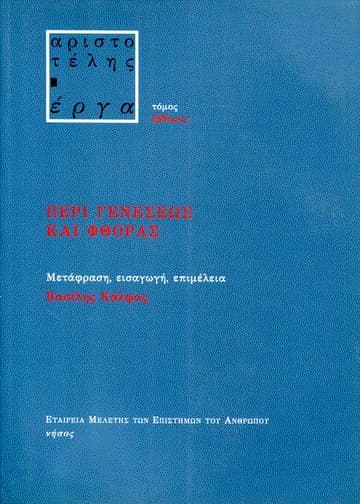
In the photo: Edition of Aristotle's treatise 'On Generation and Corruption' (translation – introduction – editing by Vasilis Kalfas, 'Nisos' publications, 2011).