
Dodoni: Restoration Works at the Sanctuary's Bouleuterion
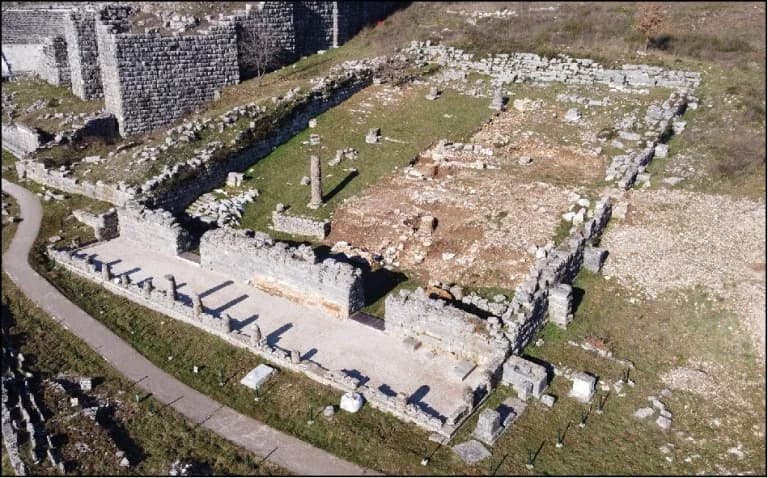
The Ministry of Culture has included restoration and enhancement works of the Bouleuterion at the Sanctuary of Dodoni in its extensive program of protection and promotion projects implemented at the archaeological site.
The project is being carried out by the Ephorate of Antiquities of Ioannina with funds from the Hellenic Parliament, in addition to the ongoing excavation research funded since 2022.
Dodoni was a place of worship for Zeus and Dione from prehistoric times. The sanctuary was initially open-air, centered around the sacred oak tree, and later a complex of buildings was constructed.
The Bouleuterion was built within the sacred precinct, near the theater, and its use is associated with the Alliance and the Common of Epirotes. Today it is centrally located in the accessible archaeological site.
The building had a single roof, three rows of columns, a Doric stoa with 15 columns on the south side, an internal cavea with steps, and an entrance from two large openings.
The Bouleuterion has three main construction phases: the first in the early 3rd century BC during the reign of Pyrrhus, the second after the Aetolian destruction (219 BC), and the third after the Roman intervention (167 BC). The final destruction of the building is placed in the earthquake of 522–528 AD.
The first excavations began in 1875 by K. Karapanos, while systematic research was conducted from 1929.