
W5: New Insights into Star Formation
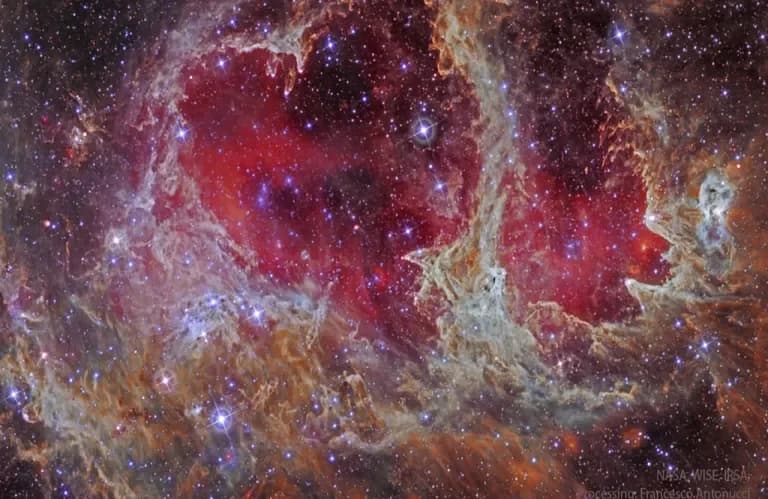
New images from the W5 star-forming region, captured in infrared light by NASA's Wide Field Infrared Survey Explorer (WISE) satellite, reveal significant evidence regarding the process of star creation.
The images suggest that the massive stars located near the center of the empty cavities are older than the stars found at the edges. This supports the theory that the older stars in the center trigger the formation of younger stars in the peripheries.
This process, known as 'triggered star formation,' occurs when the hot gas flowing out from the older stars compresses the cooler gas, creating nodes dense enough to gravitationally contract and form new stars. The impressive pillars visible in the images, which are slowly evaporating from the hot gas, provide further visual evidence of this process.
W5, also known as Westerhout 5 (W5) and IC 1848, along with IC 1805, form a complex star-forming region widely called the Heart and Soul Nebulae. The presented image covers a section of W5 spanning approximately 2,000 light-years.
The image is a scientifically colored infrared representation.